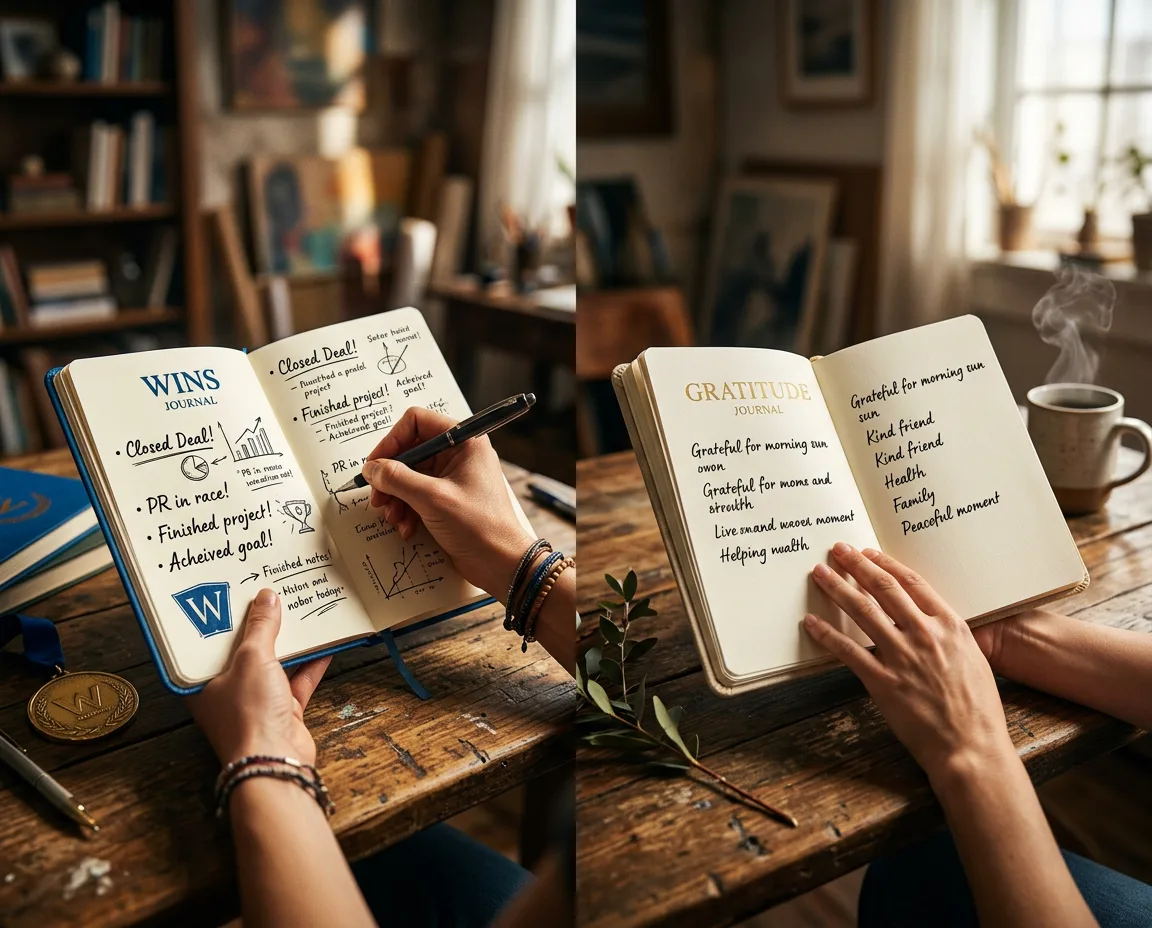
How to start a wins journal in five minutes
You can start a wins journal in five minutes: pick one place, write one line about one recent win, and stop. You've started.
The five minutes is genuinely the easy part. What keeps the journal alive is one rule, and it's the opposite of what most journaling advice teaches. We'll get to it.

In short
- Setup is three moves: choose the container, write the first entry, decide nothing else.
- Entries are one line, written when a win happens, specific enough that future-you believes it.
- No schedule. Ever. The rule that kills wins journals is the one that sounds most responsible.
How do you start a wins journal?
Start by choosing one place your wins will live: a paper jar with folded slips, a single note on your phone, or an app built for it (we compared the options in Wins journal app vs notes app). One container, so there's never a decision about where a win goes.
Then write the first entry before the five minutes are up. Look back over the past two weeks and find one thing that cost you effort, fear or discipline, and put it in one dated line. "Asked for the deadline extension instead of quietly drowning" is a perfect first entry.
That's the setup complete. No categories, no template, no goal. If you're second-guessing whether your line is win enough, read what counts as a win; the bar is cost, not glory.
What do you write, and when?
Write one line, at the moment the win happens or the same evening. The entry needs three properties: it's true, it's specific, and it's dated. Length is the enemy; a wins journal asking for paragraphs becomes a chore by week two.
When in doubt, write it. A padded jar is a myth; the actual failure mode is the empty one.
What's the rule that keeps a wins journal alive?
Here's the rule we promised: never put the journal on a schedule. Most journaling advice says write daily, and for a wins journal that advice is poison, because some weeks don't produce a win worth a line, and a forced entry teaches you the journal is a chore. Then a streak breaks, guilt arrives, and the whole thing gets abandoned.
A wins journal should only ever fill up. No daily reminder, no streak counter, no guilt for a quiet fortnight. It's a jar, not a treadmill: wins go in when life produces them, at whatever pace that is.
This is the design philosophy behind our app Cookie Jar, and it was a deliberate refusal: no streaks, no reminders, nobody else watching. The journal waits for you; it never chases you.
When does a wins journal pay off?
The payoff comes on the first genuinely bad day after your journal has some history in it, so usually within a month or two. Here's roughly how it goes.
It's Thursday of a week where nothing has worked. The project slipped, the argument happened anyway, and by evening you'd testify under oath that you never finish anything. You open the jar for the first time in weeks, and a line from March comes back: "ran the whole 5k without stopping."
The week doesn't change. But the sentence "I never finish anything" just met a dated counterexample in your own handwriting, and it doesn't survive the meeting. That's the entire product of the practice, and it's worth the five minutes.
The honest trade-off: for the first weeks the journal gives nothing back, because there's no history to draw on. You're writing to a future reader who doesn't exist yet. Push through the blank period; every entry is a message that arrives exactly once, on the day it's needed.
FAQ
What should my first entry be?
One real win from the last two weeks, in one dated line. Don't audition candidates for the most impressive; pick the first true thing that cost you something and write it down.
Do I have to write every day?
No, and you shouldn't try. Wins journals die from schedules and streaks; write only when there's a win, even if that's twice a month. The journal's job is to fill up, not to be fed.
Paper jar, notes app, or wins app?
Whichever you'll still be using in six months. Paper has ritual, notes apps have zero setup, and a dedicated app adds the part the others lack: handing you back a forgotten win on a bad day.
If you want the five-minute start with the bad-day half already built, Cookie Jar is free on iPhone and iPad: write the win in one line, drop it in, and shake your phone when you need one back. It all stays on your phone.