What is the cookie jar method?
The cookie jar method is a mental technique: you keep a collection of your hardest-won victories and deliberately reach into it when you're struggling.
Ultramarathoner David Goggins popularized it in his book Can't Hurt Me. Deep into a race, wrecked and ready to quit, he'd mentally pull out a past win, proof he'd survived worse, and use it as fuel.

In short
- The cookie jar method means collecting real past wins and revisiting one, on purpose, in a hard moment.
- It works because it's evidence, not a pep talk. You can argue with an affirmation; you can't argue with something you did.
- The method has a catch that Goggins' version glosses over, and it decides whether the jar works at all. We'll get to it.
What is the cookie jar method?
The cookie jar method is the practice of keeping a store of your past victories and pulling one out, deliberately, when you're low or mid-struggle. The name comes from Can't Hurt Me (2018), where David Goggins describes reaching into his mental "cookie jar" of past wins during ultramarathons.
Each cookie is a fact. The degree you weren't supposed to get. The debt you cleared. The 20km you ran when, a year before, you couldn't make it through one. Things that happened, with you as the cause.
How does the cookie jar method work?
The method works in three moves: notice a real win, record it, and reread one when you need it. The middle step is where most people improvise, and it matters more than it looks.
The mechanism is simple psychology. A hard moment shrinks your sense of what you're capable of; a specific memory of a past win is direct evidence against that feeling. Not "I can do hard things," but "I did that thing."
Why can't you just remember your wins?
Here's the catch we promised: memory is exactly the wrong storage for this, because your brain under-files good events and over-files bad ones. Psychologists call it the negativity bias, and we wrote about why you forget your wins separately.
Picture the moment the method is for. It's a bad day, the kind where you'd swear you've never finished anything. That's precisely when your memory serves up the failures with timestamps and leaves the wins in a drawer it won't open.
Goggins could reach into his jar mid-race because his wins were extreme enough to be unforgettable. Most wins aren't. If the jar lives only in your head, it's empty on the day you need it, which is why the method quietly depends on writing things down.
How do you build a cookie jar of your own?
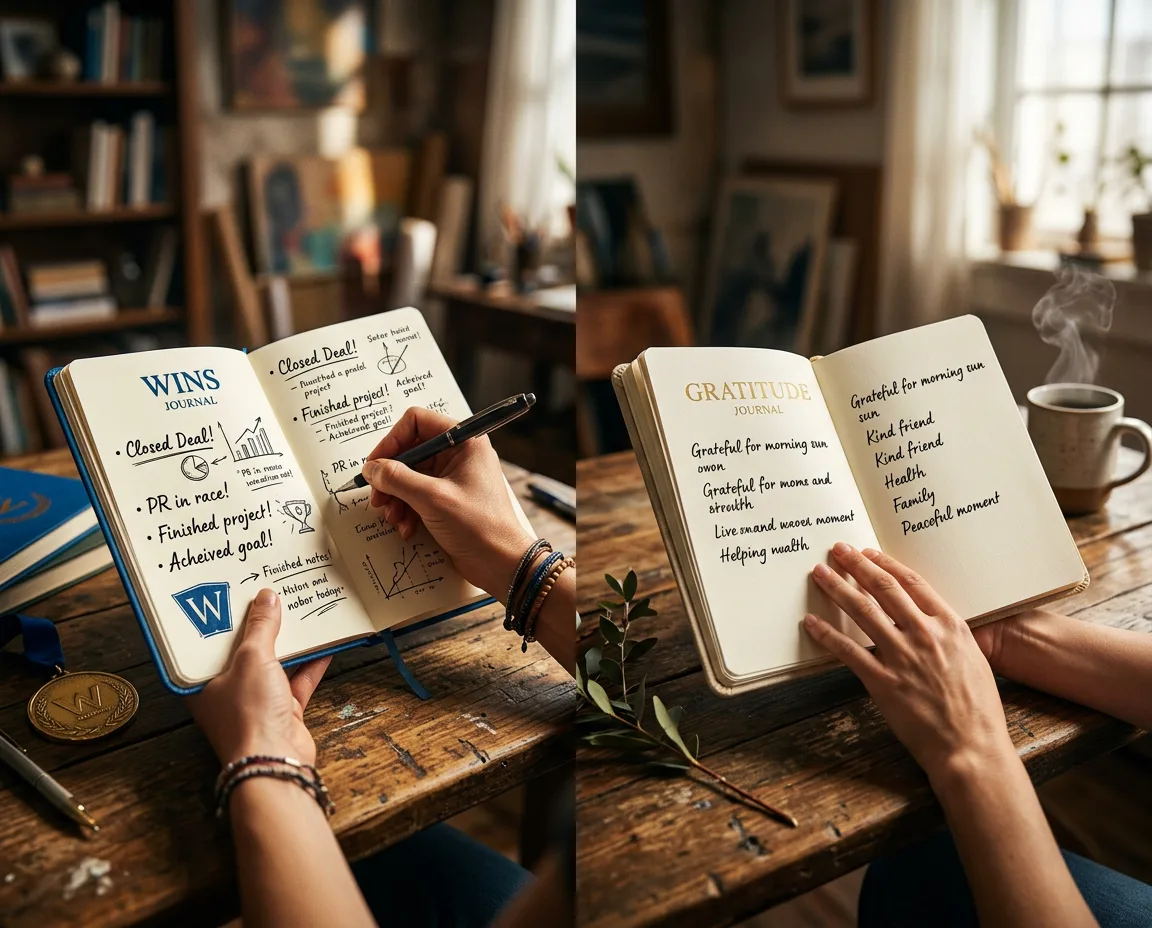
Build it with whatever you'll actually use: a real jar and paper slips, a note on your phone, or an app made for it. The rules are the same everywhere: one line per win, written when it happens, specific enough that future-you believes it. If you're unsure what qualifies, we wrote about what counts as a win.
This is the exact shape of Cookie Jar, our app named after the method. Write a win down the moment it happens, one line, and drop it in the jar. On a low day, shake your phone and one of your old wins comes back, picked at random. No streaks, no reminders, and it all stays on your phone.
One honest limit: the jar can't manufacture wins you haven't had, and it isn't a substitute for dealing with whatever is actually wrong. It's a tool for stopping a bad day from lying to you about your whole record.
FAQ
Where does the cookie jar method come from?
David Goggins named and popularized it in Can't Hurt Me (2018), drawing on his ultramarathon and military experience. The underlying idea, keeping evidence of past wins to counter present doubt, is older and shows up in journaling practice under other names.
What should go in the cookie jar?
Real, specific wins that cost you something: effort, fear, or discipline. They don't need to impress anyone else; they need to be true enough that rereading one on a bad day lands as fact, not flattery.
Is there an app for the cookie jar method?
Yes. Cookie Jar, our free iPhone and iPad app, is the method in digital form: one line per win, then shake your phone on a hard day to get one back at random. Everything stays on your device.
If you want a jar that's always in your pocket, Cookie Jar is free: write the win in one line, drop it in, and shake when you need to remember who you are.