Why you forget your wins (and how to fix it)
You forget your wins because your brain treats bad events as information and good ones as decoration. Psychologists call it the negativity bias.
It isn't a flaw in you specifically, and it isn't fixable by trying to think more positively. It's an accounting error built into everyone, and it responds to exactly one thing: an external record.

In short
- The negativity bias means negative events get more attention, more memory and more weight than positive ones.
- The bias made evolutionary sense; missing a threat cost more than missing a windfall. Applied to your own record, it's slander.
- There's a thirty-second test that shows you the bias running live in your own head. We'll get to it.
Why do you forget your accomplishments?
You forget accomplishments because human cognition systematically privileges the negative: a research review in Psychological Bulletin documents the asymmetry, with people weighting negative information more heavily than positive across attention, memory and judgment.
In practice the asymmetry feels like this: criticism from 2019 available word-for-word, compliment from last Tuesday already gone. The bad meeting is a permanent exhibit; the good year around it never got catalogued.
What does the negativity bias do to your self-image?
Over time, the bias writes a false biography: since failures are stored sharply and wins fade, honest introspection reads a distorted record and concludes you haven't done much. The data is corrupted at the point of storage, so no amount of rereading it fixes the conclusion.
Now the test we promised. Name three things that went wrong for you in the past year; then name three wins from the same year. If you're like most people, the failures arrived instantly, with dates and dialogue, and the wins needed real excavation. Same year. Same life. Different filing system.
That half-minute is the whole argument. You just watched one archive open itself and the other stay shut, and you now know which version of you writes the story on a bad day.
How do you fix forgetting your wins?
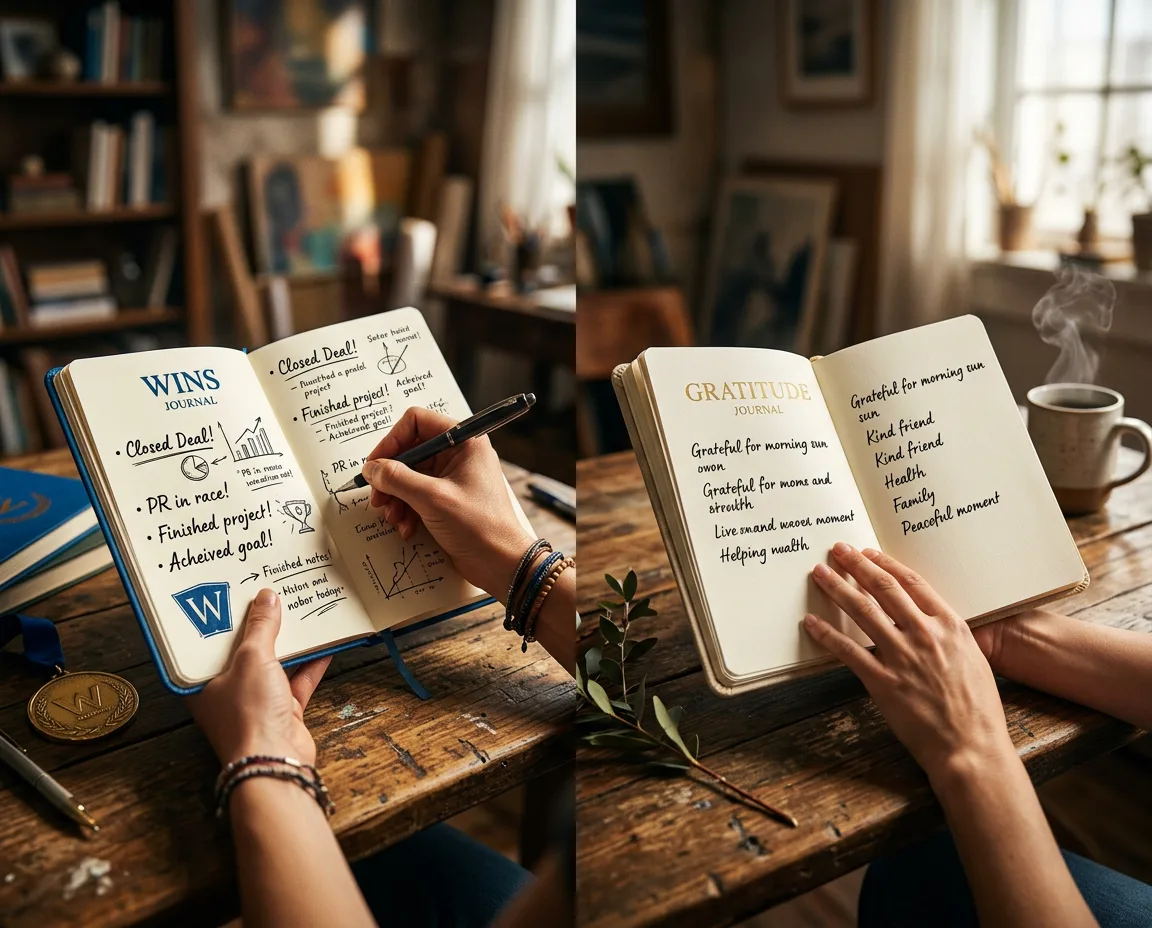
You fix it with an external record, because the bias corrupts storage and an external record can't be corrupted. Write the win down when it happens, in one line, somewhere permanent, and the negativity bias loses its editing power over that entry forever.
The fix has two halves, though, and the second is the one people skip: rereading. A record you never revisit rebalances nothing. This is the entire design behind the cookie jar method, and behind our app Cookie Jar: write a win down the moment it happens and drop it in the jar; on a low day, shake your phone and one comes back, picked at random, from the archive your brain refused to keep.
The honest limit: the bias doesn't switch off. A wins record compensates for it the way glasses compensate for eyesight; stop using it and the old filing system resumes. And if the low days are most days, a journal belongs alongside professional support, not in place of it.
FAQ
Is it normal to forget your accomplishments?
Yes, it's the default setting. The negativity bias is a well-documented feature of human cognition, not a personal failing, which is exactly why the fix is a written record rather than more willpower.
Does rereading old wins actually help?
Rereading is the mechanism doing the work: a specific recorded win is direct evidence against the "I never do anything right" feeling, and evidence is harder to dismiss than encouragement. A record that's never reread changes nothing.
What if I genuinely can't think of any wins?
The bias has set your bar at "impressive" when it should sit at "cost me something." Getting through a hard month counts; so does the thing you didn't do. We wrote a whole piece on what counts as a win.
Your brain will keep dropping your wins; that part isn't negotiable. Cookie Jar is the free countermeasure: one line per win, kept on your phone, handed back to you with a shake on the days the bias is loudest.