Why we build for Urdu-speaking Christians first
We build for Urdu-speaking Christians first because we are Urdu-speaking Christians, and it is the only audience whose software we can judge without asking anyone.
That is not a mission statement and it is not charity. It is the ordinary reason a small studio picks a first audience: we know what is wrong with the apps these readers have, because we are the readers.
In short
- The audience is small and commercially unattractive, which is why nobody had taken it.
- Belonging to it is a practical advantage, not a virtue: we can tell when something is wrong in an afternoon.
- The property that makes this work is the same one that makes it fail, and it fails in a specific direction.
Why start with a small audience?
Because a small audience you understand beats a large one you have to research. Every question that would otherwise need a study has an answer you already know.
Take a real example. Our hymnal indexes every song by number and prints its page number from the printed book alongside. Nobody specifies that from a market survey; you specify it because you have sat in the service where a number is called and watched a room lose the first verse to a page hunt.
The feedback loop is the other half. When something is wrong somebody tells us at church, which is faster than instrumentation and just as well, given that we collect no data at all.
Why is this audience underserved?
Arithmetic, not neglect. Urdu-speaking Christians are a minority inside a minority, and then the readership splits again by script.
Follow the numbers a company would follow. Ethnologue counts around 78 million native Urdu speakers, which sounds substantial until you narrow to Christians, then to those who want scripture on a phone, then split that between readers of Nastaliq and readers of Latin letters. Whatever is left will not repay a salaried team.
So nobody built it, and the gap is not evidence that anyone behaved badly; it is what happens when a group is too small to be a market. Our own numbers make the point: Urdu Bible has thirteen reviews.
That is also the opportunity, unsentimentally. An audience nobody competes for is one a three-person studio can actually serve well, and there is no version of this where we out-build a funded team on a mainstream product.
What does knowing the audience buy you?
It buys you the right problem, which is the expensive thing to get wrong.
The clearest case is the Roman Urdu line. It exists because neither of us reads Nastaliq comfortably; we know the hymns by sound, and a book in the script alone was no use to us. It is not a user need we identified, it is one we had, and the fact that many people speak Urdu without reading the script is why it mattered to anyone else.
That is the un-noble version and the accurate one: we built the thing we wanted and it was missing for other people too. The design consequences followed, including showing both scripts at once rather than a switch.
Where does this approach go wrong?
Here is the failure we promised, and it is the flip side of the advantage: when you are the audience, you generalise from yourself and stop noticing.
We are two people who cannot read the script well, so we built for that reader and probably over-serve him. A reader fluent in Nastaliq may find a permanent Roman line under every verse to be clutter, and we cannot know how many we are annoying, because we do not measure and they are not the people we run into. Older readers, readers who want study apparatus, readers whose Urdu is Punjabi-inflected: all further from us than we would like to admit.
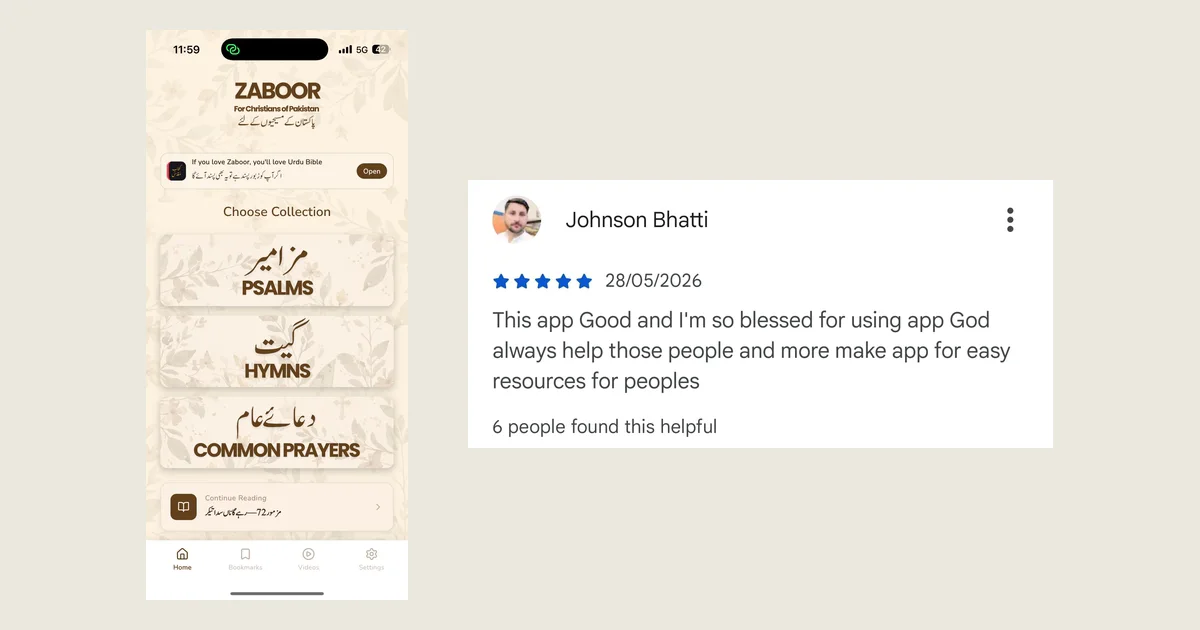
The one real correction is other people. Our hymnal's biggest feature came from outside the two of us, when Rev. Clement Maurice asked why hymns could not link to recordings so a person could hear how a song is sung. Daily actives went from roughly three hundred to seven hundred. We would not have thought of it, which is the point of why we built Zaboor.
This is also not a growth strategy. The audience stays small, the apps stay free, and the commercial work funds them. Anyone reading it as a clever market-entry play has it backwards.
FAQ
Will you build for other languages or communities?
Possibly, but not by guessing. The advantage here is that we can check our own work; we would have no such advantage in a language none of us reads, and we would rather not ship a script we cannot proofread.
Is building for a small audience a business decision?
No. The free apps earn nothing and are paid for by the studio's commercial work. The audience was chosen because we understand it, not because it would return anything.
Do you have to be an Urdu-speaking Christian to use the apps?
No. They are free, on both stores, with no sign-up, and anyone can install them. The apps were designed around a specific reader, which is different from being restricted to one.
If you are that reader, Urdu Bible has all 66 books in Urdu with a Roman Urdu line under every verse. Free, offline, no ads.