Urdu Bible vs Zaboor: which one do you need?
Urdu Bible is the complete Bible. Zaboor is a hymnal. If you want to read scripture you want the first; if you want to sing in a service you want the second.
We build both, and they get confused for each other constantly, mostly because both are free Urdu apps with Roman Urdu alongside the script.
In short
- Urdu Bible contains all 66 books of the Old and New Testaments, set for reading.
- Zaboor contains 150 Psalms and more than 300 hymns and geets, indexed by number, set for singing along.
- Both are free, ad-free, and carry Roman Urdu with the Urdu script; only one of them works with no signal at all.
What is in Urdu Bible?
Urdu Bible contains the complete Bible in Urdu: all 66 books of the Old and New Testaments, with a Roman Urdu line under every verse.
The whole app is a reading screen. Every verse appears in Nastaliq with its Roman transliteration beneath, you can jump to any book, chapter or verse, search the whole text by word or reference, size the type up and switch to night mode. It is a reading Bible rather than a study Bible, so there are no commentaries, maps or footnotes.
It reads with no internet at all and declares no data collected and no data shared.
What is in Zaboor?
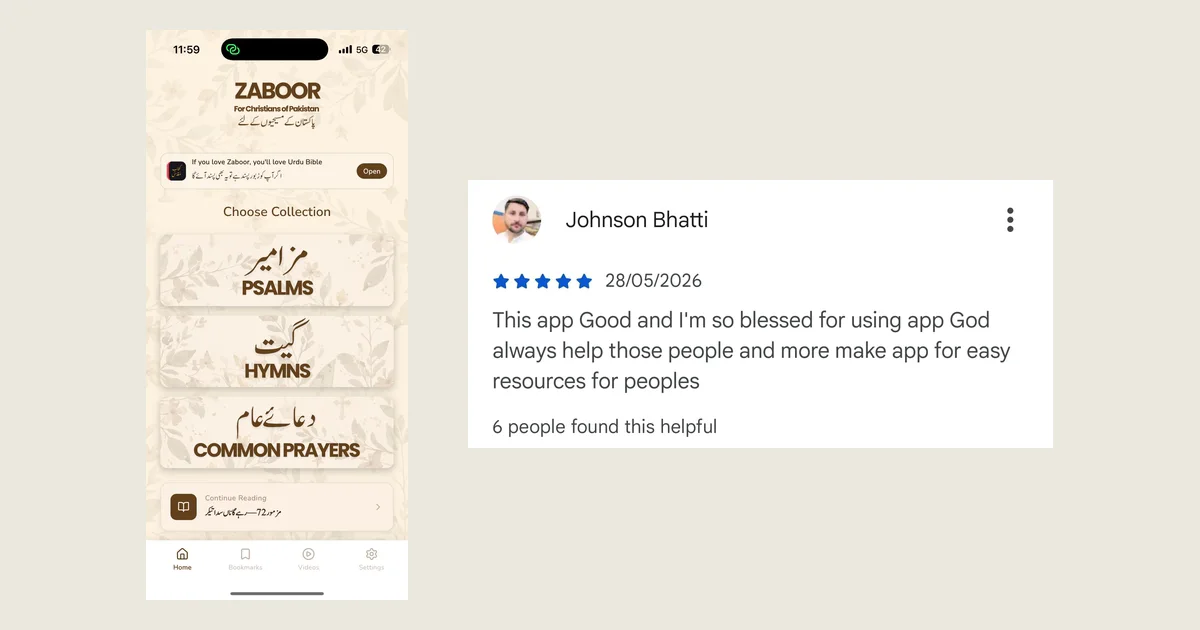
Zaboor contains 150 Psalms and more than 300 hymns and geets, in Urdu, Punjabi and English, organised into three collections: Psalms, Hymns and Common Prayers.
It is built around the way songs are called out in a service. Everything is indexed by number, because that is how a hymn is announced, and every song carries its page number from the printed hymnal so a congregation can use the app and the book at the same time. Each song is set in Urdu script with Roman Urdu beneath it.
Zaboor also links out to recordings on YouTube, so you can hear how a song is sung rather than only read it. That feature is why the app is not quite fully offline: the text is all on the device, but the videos are links. We told the whole story of building it in why we built Zaboor.
Which app do you actually need?
Pick by what you are holding the phone for. If you are reading, you need Urdu Bible; if you are singing, you need Zaboor.
Here is the case that catches people out. You are in a service, a number is called, and you open the Bible app looking for it. Psalm 23 is in both apps, and they are not the same thing in each: in Urdu Bible it is the scripture text of the psalm, and in Zaboor it is the sung version the congregation actually uses, with a number and a tune behind it. The words differ because the purposes differ. Neither app is a substitute for the other at that moment.
The reverse trips people too. Zaboor's Psalms collection looks like it might cover scripture, and it does not: it stops at the Psalms, and it holds them as songs. There is no Genesis in Zaboor and there never will be.
What do the two apps have in common?
Both are free with no ads, both pair Urdu script with Roman Urdu, and both are built by the same three people.
That shared pairing is deliberate and it is the reason the two apps get mixed up. A large part of the Pakistani Christian community speaks Urdu fluently without reading the script comfortably, so an app that ships script alone serves only the people who were already fine. Both apps therefore carry both lines, and in both cases the Roman line is a transliteration and not a translation: the same Urdu words, respelled in Latin letters.
The honest difference in reliability is the connection. Urdu Bible needs no network for anything it does. Zaboor needs none for the words and needs one for the recordings, which matters if the hall has no reception and you were counting on hearing the tune.
FAQ
Does Zaboor include the Bible?
No. Zaboor holds 150 Psalms as songs, plus hymns, geets and common prayers. It contains no other book of the Bible, and its Psalms are the sung versions rather than the scripture text. For the complete Bible in Urdu, that is Urdu Bible.
Can I use both apps at the same time?
Yes, and many people do. They serve different moments: Zaboor during a service when numbers are being called, Urdu Bible when you are reading a passage. Both are free, both are small, and installing one does not affect the other.
Are both apps free and ad-free?
Yes. Both are completely free, carry no advertising, and require no account or sign-up. Neither has ever charged for anything.
If it is scripture you are after rather than songs, Urdu Bible gives you all 66 books in Urdu and Roman Urdu. Free, offline, no ads.